Jobs are growing almost everywhere, but not evenly. Across the 264 occupation groups covered by this site, official projections add about 781,000 jobs by 2030, and the growth is concentrated in health, care, IT, and business roles. A handful of mostly office-support jobs are shrinking.
Source: JSA. Projections: JSA Employment Projections, May 2025 base. 2030 projection minus 2025 base, all 264 groups. How we check our facts
One caution: the official projections give totals for 2030 and 2035, not year by year, so there is no 2027 number. The data clearly show the direction of travel, and this post follows that.
781,000
more jobs by 2030 across the 264 occupation groups on this site, a rise of 6.5% on the 2025 base.
Source: JSA. Projections: JSA Employment Projections, May 2025 base. How we check our facts
What the 2026 numbers showed
In the year to February 2026, 168 of the 264 groups added jobs and 95 lost them. Across the 261 groups with a net change figure, the total was about 258,700 more jobs. Aged and disabled carers added 27,100, ahead of software and applications programmers (13,700) and registered nurses (12,600). See the Aged Care Support Worker, Software Developer and registered nurses pages.
Source: ABS · JSA. Employment: ABS Labour Force via Jobs and Skills Australia (JSA), February 2026. Net change over the past year, as published by JSA. How we check our facts
Not everything grew. Livestock farmers lost about 4,000 jobs, cooks about 3,500 (a fall of 10.2%), painting trades workers about 2,300 and bank workers about 2,100. A year of losses is a signal to look closer: see the cooks page.
Source: ABS · JSA. Employment: ABS Labour Force via Jobs and Skills Australia (JSA), February 2026. How we check our facts
Where people work today
Our 264 groups employ about 12.2 million people between them. Five groups each employ more than 240,000 of them: sales assistants (about 562,000), aged and disabled carers (376,000), registered nurses (366,000), general clerks (292,000) and retail managers (247,000). See the Sales Assistant and Administration Assistant guides.
Source: ABS · JSA. Employment: ABS Labour Force via Jobs and Skills Australia (JSA), February 2026. Rounded to the nearest thousand. How we check our facts
Where growth is expected by 2030
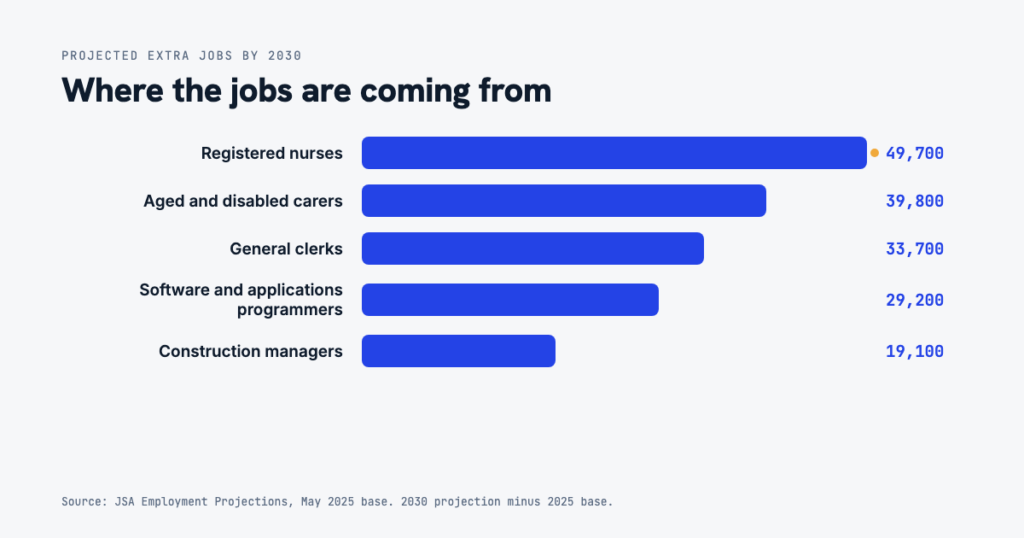
Five groups each add more than 19,000 jobs by 2030: registered nurses (about 49,700), aged and disabled carers (39,800), general clerks (33,700), software and applications programmers (29,200) and construction managers (19,100). Courses that lead into this work include Certificate III in Individual Support and Diploma of Information Technology.
Source: JSA. Projections: JSA Employment Projections, May 2025 base. How we check our facts
Size and speed are different things. Ten groups with at least 20,000 jobs are projected to grow by more than 15% by 2030, including dental practitioners (20.0%), medical imaging professionals (18.1%), other medical practitioners (18.0%) and psychologists (16.8%). Software and applications programmers sit in that list too (15.7%). See the dental practitioners, medical imaging professionals and psychologists pages.
Source: JSA. Projections: JSA Employment Projections, May 2025 base. Groups with a 2025 base of at least 20,000 jobs. How we check our facts
Which fields carry the growth
Group the occupations by the fields used on this site and a pattern shows. IT and cyber security (13.8%), health (13.5%) and care and community (11.1%) are projected to grow at double-digit rates by 2030. Trades and construction (5.2%) and business and admin (5.9%) grow more slowly, yet business and admin still adds about 263,000 jobs, a third of the total, because it is so large. Browse the career guides by field to see where a job sits.
Source: JSA. Projections: JSA Employment Projections, May 2025 base. Fields follow the ANZSCO group rule used on this site; rate is jobs added by 2030 over the 2025 base. How we check our facts
Tip
Open the occupation page for a job you are considering and read the 5 and 10 year growth next to the pay. A job can pay well and shrink, or grow quickly and pay near the middle. Seeing both numbers before you choose a course is the point.
What is shrinking
Five of the 264 groups meet our shrink rule, which is at least 3% fewer jobs in 2035 than in the 2025 base: personal assistants (5.8% fewer), secretaries (5.6%), timber and wood process workers (3.5%), keyboard operators (3.5%) and meat boners and slicers, and slaughterers (3.4%). That is a small share, but it is real.
Source: JSA. Projections: JSA Employment Projections, May 2025 base. Shrink rule: 3% fewer jobs or more, 2025 base to 2035. How we check our facts
More groups dip on the way there. By 2030, 30 groups are projected to have fewer jobs than in 2025, including personal assistants (about 3,800 fewer), keyboard operators (2,800) and secretaries (2,300). Over the same period general clerks add about 33,700 jobs. Office work is not disappearing, but some roles inside it are. See the Executive Assistant guide and the secretaries and keyboard operators pages.
Source: JSA. Projections: JSA Employment Projections, May 2025 base. How we check our facts
What pay adds to the picture
Pay is a separate question from growth. Across the 180 occupation pages with a pay figure, the middle of the median full-time weekly pay figures is $1,787. The range runs from $1,112 (pharmacy sales assistants) to $5,013 (other medical practitioners). Two groups adding many jobs sit well above the middle: registered nurses at $2,192 a week and electricians at $2,191.
Source: ABS · JSA. Pay: ABS Employee Earnings and Hours, May 2025, via JSA. The middle is the median across occupation pages. How we check our facts
What to expect in 2027, and what to do with it
Treat 2027 as one more step on the same path, not a separate forecast. The direction in the data is steady: care, health and IT keep growing at double-digit rates, trades and business add jobs through sheer size, and some support roles keep shrinking. If you are weighing a study decision, check three things on the page for the job you want: the pay, the growth to 2030 and the nationally recognised courses that lead there.
Key takeaways
- Jobs are projected to rise by about 781,000 (6.5%) across our 264 groups by 2030, but the projections stop at 2030 and 2035, so there is no 2027 figure.
- IT, health and care and community grow at double-digit rates, while business and admin and trades add jobs mainly because they are large.
- Five groups are projected to shrink by 2035 and 30 have fewer jobs by 2030, so check the occupation page before you choose a course.